We're hiring! Visit our careers page to learn more!




A New Year’s resolution is a personal commitment or promise to achieve a goal or adopt a positive habit in a new year. Change can happen at any time, but there’s something about a new year that makes people reflect on the past and consider ways they want to improve in the next 365 days.
New Year's resolutions are sometimes seen as vain pursuits. Something that is bound to be broken in a month or so, so why try? However, with the right outlook, goals, and support, it’s possible to see long-term change from a New Year’s resolution.
In this article, we’ll talk about how to set New Year’s resolutions, how to keep them, and the most common New Year’s resolutions.
When New Year’s resolutions are broken, it’s rarely the person’s fault. Often, goals are just not achievable.
If you want your resolutions to succeed and lead to lasting change, you need to consider how you’re choosing your goals. Here’s what you need to know about setting successful New Year’s resolutions.
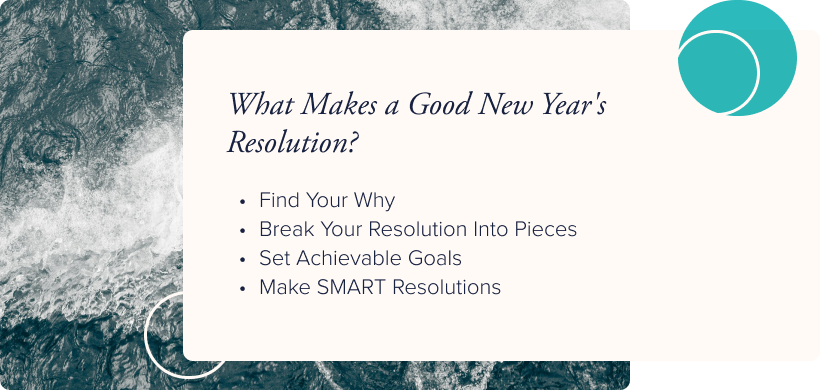
If you don’t have a reason to set a resolution, it won’t stick. Why do you want to set a resolution?
You might already know what your resolutions are: go to the gym every week, read a book a month, or have people over once a month. All of these are good resolutions, but without the reason, there’s no meaning.
Why do you want to go to the gym every week? Maybe its to lose weight or feel all around healthier. Why read a book every month? Is it for brain stimulation, or so you can make social connections?
Related Article: How to Focus on Yourself
The reason for the resolution will act as your guidepost and motivator for maintaining your goals throughout the year.
How do you eat an elephant? One piece at a time.
Large goals can feel impossible to tackle, and will leave you feeling unmotivated. It’s important to have a day-to-day plan, or microgoals. If you want to read 12 books, give yourself a target of one book a month and set aside time every week to read.
The same idea can be applied to all kinds of goals. If you want to get stronger, set smaller goals for increasing your weights to motivate you along that journey.
Accomplishing small goals on your way to finishing a large goal will provide more motivation and steam instead of trying to only accomplish the large goal.
Be real with yourself. Is your resolution something you can actually do?
Using reading more as an example, if you’re used to reading 2-5 books in a year, it might not be beneficial, or realistic, to set a goal of reading 100 books in the year. While it may be a lofty goal, it may not be helpful to immediately shoot for such an intense goal.
Don’t think you can’t try to achieve those lofty goals, but when it comes to creating a timeline that will motivate you toward completion, achievability is more helpful.
Smart goals are:
If you follow this criteria for your New Year's resolutions, you’re well on your way to affecting positive, real change in the new year.
Doing a 30-minute workout every week for the entire year is an example of a SMART goal. There’s a timeline that defines how long it will take to succeed, as well as a time limit on what the workout should look like. This is a standard that can be measured and is easy to understand. It also gives a little bit of grace by not defining what days of the week the workout has to happen.
Before setting your New Year's resolution in stone, make sure it’s specific, measurable, achievable, realistic, and timed.
New Year’s resolutions are better practiced than planned.
Once you understand what you want to do, why, and how, it’s time to start doing. However, if you’re like most people, you’ll likely miss your goals unless you have a plan.
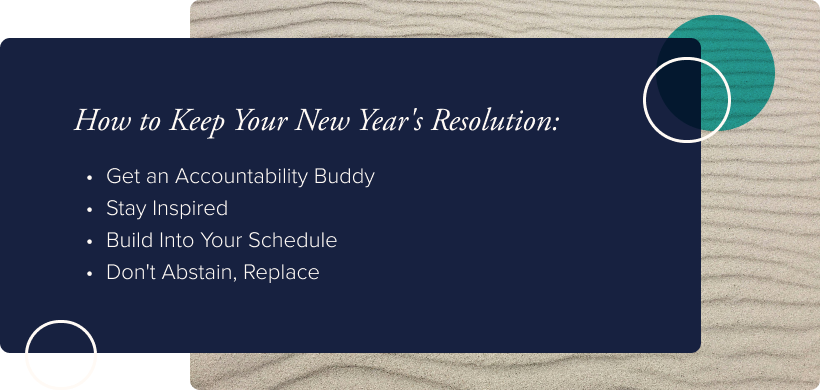
Having a friend who can check in and see how your goals are going is a great tool for keeping your New Year’s resolutions.
Anyone can be an accountability partner. Coworker, friend, family member, wife, husband, or therapist. Your accountability buddy should be someone you trust. If they also have a New Year’s resolution, that’s a great opportunity to keep each other accountable.
Motivation is so important for keeping your resolutions. Sharing your progress with someone else is a great way to keep you motivated.
Instead of trying to achieve a goal in a vacuum, surround yourself with things that inspire you toward your goals.
Listen to podcasts that keep you interested in your resolution. Read books, seek community, and post notes around your space.
Some of these things will feel more like homework than others. Try to keep inspirations around you and refresh them when needed.
Healthy habits don’t just happen. You’ll need to think of ways to include your New Year’s resolution into your daily, weekly, or monthly life.
When you’re able to adopt your resolution into your daily life, it stops feeling like work and more like life.
Many resolutions involve not doing something: don’t drink, stop spending so much money, or quit gossiping. These are great resolutions, but they can be hard to maintain.
If you want to successfully stop doing something, you need to replace that habit with something positive.
If you want to stop using your phone so much, maybe replace phone use with reading. Instead of drinking alcohol, drink a special non-ABV drink instead.
Reframing abstinence-focused resolutions with positive actions you can do is an easy way to find motivation.
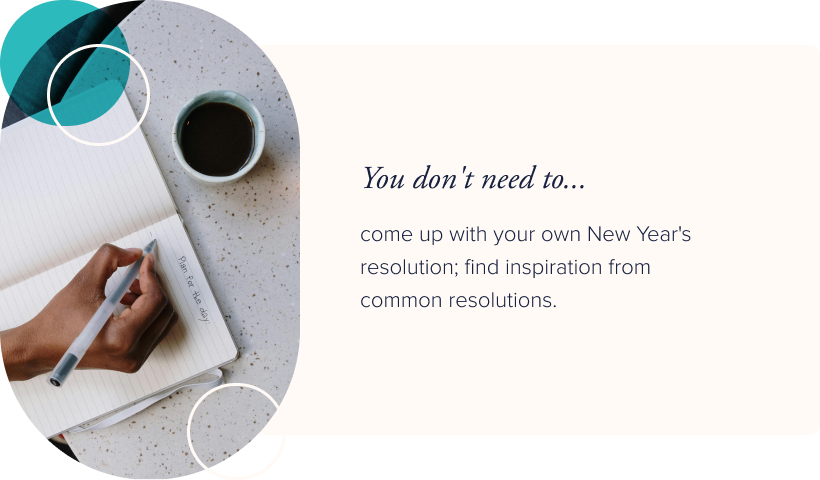
It can be hard to come up with a New Year’s resolution on your own. Here are some examples of New Year's resolutions you can choose or find inspiration from.
If you want to work on being a more grateful person, sending handwritten letters is one way of practicing gratitude.
You can make a SMART goal to write a nice note for someone weekly. You could send them encouragement or mention what you appreciate most about them.
Reading can help you reduce screen time and increase your knowledge and brain functioning. It’s a great way to replace negative habits and is a good habit.
Pick a specific number of books you want to read and choose your books ahead of time. This can motivate you to complete each book.
Mindfulness is a great tool for increased mental health, and it’s a muscle that can be trained. You can set a resolution to be more mindful by creating a goal to practice mindfulness exercises.
Mindfulness exercises include journaling, breathing exercises, and movement exercises. It’s important to make sure your resolution is SMART.
Attending therapy is a great way to support your mental health in the new year. General mental health counseling is a place for people to find support for their day-to-day issues
Inner Balance Counseling is an Arizona-based trauma-informed therapy practice that offers in-person and online mental health counseling services for issues ike trauma, PTSD, anxiety, depression, and relationship issues.
If your New Year’s resolution is to start therapy, contact us and start keeping your resolutions.
Related Articles: How to Email a Therapist for the First Time, What to Talk About in Therapy
Sign up with your email address to receive news and updates.

%201.svg)
With both in-person and online therapy options, we want to make therapy accessible and inclusive.
Your message will be sent directly to the therapist or counselor via email. Email is not fully secure during transit, so please avoid sharing sensitive information such as medical or insurance details. Your messages are also stored securely in our protected message center, accessible only to the professional you contact.
By using this form, you agree to our Privacy Policy and Terms, and consent to your message being sent and stored as described.
If this is an emergency do not use this form. Call 911 or your nearest hospital.
This site is protected by reCAPTCHA and the Google Privacy Policy and Terms of Service apply.