We're hiring! Visit our careers page to learn more!



A Battle For Motivation

Every day is a chance to start over. Our trauma-informed therapists will meet you where you are — in person or online — so you can process your experiences and become the person you want to be.
Have you ever tried engaging in an activity you love, but found you either found it boring or your enjoyment was numbed? This is a normal feeling that almost everyone can relate to, and it’s called apathy.
While apathy can come and go, there are times when it becomes a chronic issue that hinders all areas of life.
In this guide, we’ll cover everything you need to know about apathy, including:
Apathy is an intense lack of interest. It can demotivate people and leave them feeling empty. This can affect:
Almost everyone will feel apathetic at some point in their lives, but some people experience it chronically. This can cause long-term complications and make life incredibly difficult.
Because apathy affects a person’s ability to care, it can be hard to pinpoint what the symptoms are. Naming apathy symptoms can help you understand what’s happening and how to deal with it.
Here are some of the symptoms associated with apathy:
Symptoms of apathy can range from inconvenient to distressing.
Related Article: Doomscrolling
The cause for apathy ranges from mental health struggles, situational problems, and neurological complications.
Physical complications to the brain can cause apathy.
These issues disrupt communications within the brain, causing dysfunctions in reward processing, dopamine signaling, and executive functions.
Many mental health issues include apathy as a symptom. The mental health considerations most closely associated with apathy include:
If you’re experiencing apathy due to any of these issues, mental health treatment or therapy can help you find ways to manage symptoms and deal with your apathy.
Related Article: Depression
Apathy is often triggered by life events. These may include:
When you feel exhausted from big changes, it’s typical to feel more withdrawn and overwhelmed. This leads to feelings of apathy. Maybe you’re too busy, distracted, or overwhelmed to care about the things you used to. Whatever the issue, you’re not alone, and you can learn to manage these distressing feelings.
Related Article: What Is and Isn’t Burnout?, How to Deal With Compassion Fatigue
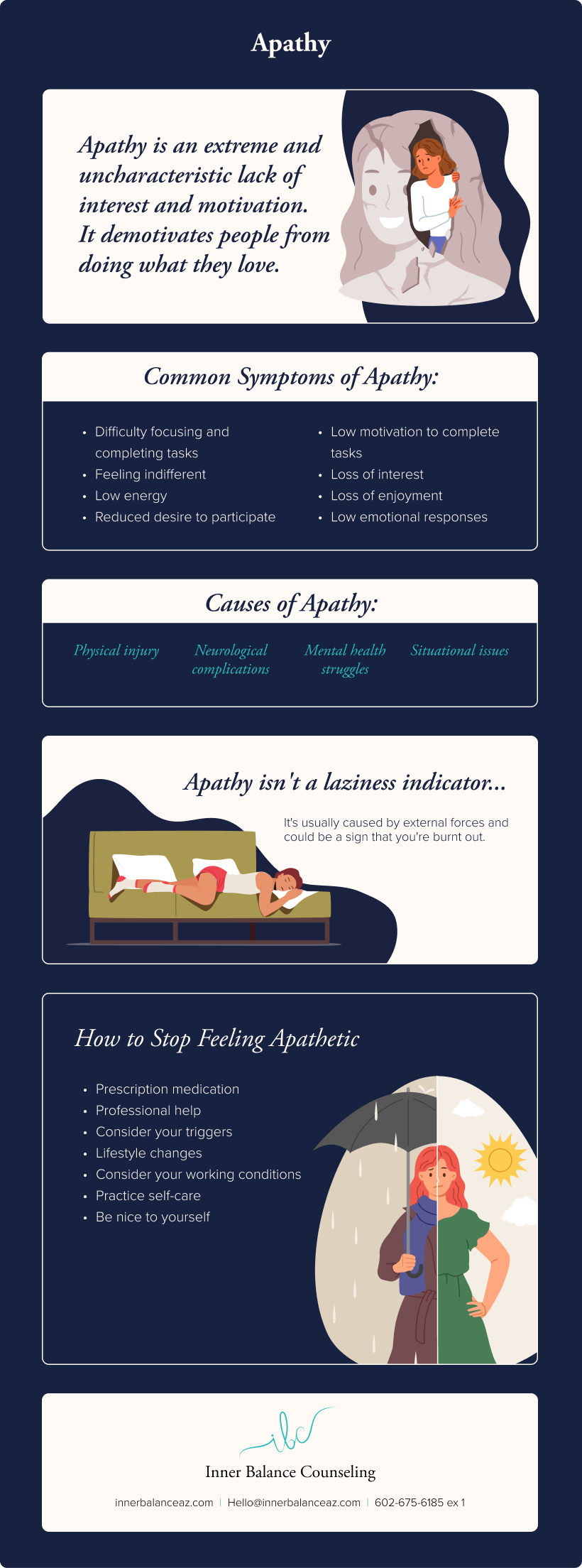
Apathy doesn’t feel good. It can be distressing to feel like you can’t do the things you used to enjoy. Like you want to care and get focused, but something just isn’t clicking.
Apathy is a well-documented issue that many people struggle with. These are some ways you can try to deal with apathy.
If your apathy is caused by a physical ailment or a neurological issue, there may be prescription medication that can help.
If you have apathy due to depression, antidepressants can help improve some apathy symptoms.
If you’re wondering if prescription medication is a good idea for your situation, talk with your health care provider, and never take prescription medications outside of their guidance.
Therapy isn’t only for people in a crisis. It’s a place to process frustrations from everyday issues and problems. Apathy might seem like a small issue, but if it’s getting in the way of the life you want to live, it may be time to consider attending counseling.
Some causes of apathy can be treated with the help of counseling and therapy. Issues like:
While in counseling, you’ll develop coping skills, learn about yourself, and work through any unprocessed trauma. This can help you get a better idea about what’s causing your apathy and how to avoid it.
Understanding what events or issues occurred around the time of developing apathy can help you better understand how to move past it.
Consider these questions to help you better understand your issues with apathy:
This is not an exhaustive list of questions you should be considering, but they can help you get on the right track for understanding what triggers your apathy.
If you’re able to understand what makes you feel apathetic, you may be able to make some changes here and there to help manage your apathy symptoms.
Some lifestyle changes that can help people with apathy include:
These changes are not intuitive and may take some research on your part. However, when taking a holistic approach to apathy, you’ll likely start to see changes soon.
Work is often the source of apathy for many people, and for good reason. It’s easy for work tasks to become dull, boring, and repetitive.
If you find yourself feeling apathetic about your work, consider looking for ways to liven up your work situation.
Changing things up can help give context to what you can enjoy about your work. Talking with managers about what you’re feeling can also open opportunities to work on projects and locations that you actually enjoy.
Think about what parts of your job are truly interesting to you and try to find ways for you to pivot into those roles.
When you feel burnt out and overwhelmed, it’s easy to forget about yourself. You may feel too tired or distracted to consider ways you can try enjoying yourself.
Self-care can be a particularly helpful tool for moving past your apathy. It works in two ways:
Self-care can look like almost anything, including:
Self-care can also help you engage in tasks that you find boring and uninteresting. By thinking of self-care as a treat for doing something you’re apathetic about, it can motivate you to be more engaged.
As you try to manage apathy and get back to feeling motivated, you’ll likely hit a lot of speed bumps along the way. Try to recognize that it’s a process that will take time.
Apathy is not something that you can just shrug off. It’s usually caused by external issues, and it’s usually not your fault.
When you’re experiencing apathy, work on being gracious to yourself. Practice self-compassion when your best efforts don’t work.
Counseling can be helpful for all the issues in life. Whether you’re experiencing apathy due to a mental health issue or just can’t seem to get encouraged about life, general mental health counseling can help you better understand what you’re experiencing and how to move past it.
At Inner Balance Counseling, we help people live the life they want by providing personalized mental health care. We help a wide variety of clients live a more fulfilling life.
Request a consultation and start taking control of your apathy.




We know asking for help is hard, that’s why we want to make it easy for you.
Sign up with your email address to receive news and updates.
%201.svg)
With both in-person and online therapy options, we want to make therapy accessible and inclusive.
Your message will be sent directly to the therapist or counselor via email. Email is not fully secure during transit, so please avoid sharing sensitive information such as medical or insurance details. Your messages are also stored securely in our protected message center, accessible only to the professional you contact.
By using this form, you agree to our Privacy Policy and Terms, and consent to your message being sent and stored as described.
If this is an emergency do not use this form. Call 911 or your nearest hospital.
This site is protected by reCAPTCHA and the Google Privacy Policy and Terms of Service apply.