We're hiring! Visit our careers page to learn more!




Trauma is a nuanced concept. It can seem like someone becomes traumatized after experiencing a horrible event, but this isn’t always the case.
The truth is, trauma can come in many different forms. Some forms of trauma are much easier to recognize than others, but they can all lead to similar symptoms and long-term effects.
To help people understand which type of trauma they’ve been affected by, certain traumatic events are labeled as big T trauma while others are labeled as little t trauma.
Big T and little t trauma are general ways of classifying trauma based on the severity of someone’s traumatic experience. Intense experiences usually lead to big T trauma, whereas milder experiences often result in little t trauma.
Just like many other mental health conditions, trauma exists on a spectrum. These classifications are often used to describe traumatic experiences on each end of the spectrum, so there will naturally be some overlap in the middle.
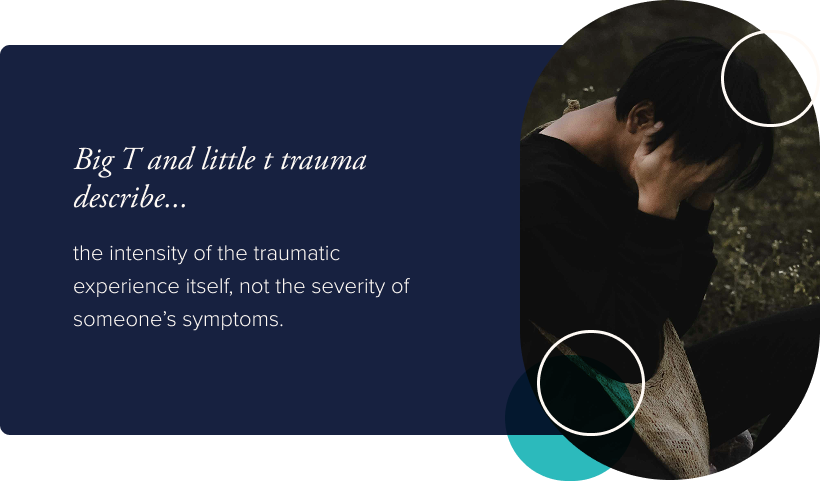
It’s also important to understand that big T and little t trauma describe the intensity of the traumatic experience itself, not the severity of someone’s symptoms. It’s possible for someone with little t trauma to be more severely impacted by their traumatic experiences than someone with big T trauma.
Big T trauma usually comes from extreme or life-threatening experiences. These are the high-impact events that most people immediately associate with the word trauma.
Common examples of big T trauma include:
These experiences are easier to recognize because they involve an obvious danger to someone’s physical and mental wellbeing. They also make it easier to connect someone’s trauma-related symptoms directly to a specific, singular event.
Little t trauma refers to events that are distressing on a personal level but are not necessarily life-threatening. While the name might make them sound small, the impact they have on your nervous system can be massive—especially if they happen repeatedly.
Common examples of little t trauma include:
Because these events are often viewed as part of life, we tend to dismiss them. However, when these stressors accumulate over time, they can cause just as much damage to your mental health as a single Big T event.
Related Article: Can emotional trauma cause brain damage?
Regardless of whether a trauma is labeled big or little, the way it shows up in your daily life can look the same. Our bodies and minds react to distressing events by trying to protect us, which can lead to a variety of symptoms.
Some of the most common trauma symptoms include:
These responses are common signs that your nervous system is still carrying the effects of past trauma. With the right support, it is possible to understand these patterns and begin the process of healing.

Related Guide: Trauma Therapy
Here are a few ways to know if you are living with the effects of an unresolved traumatic experience:
The most important thing to remember is that your feelings are valid. You do not need to justify your trauma based on how big or small the event was; if it affected your ability to function and feel safe, it is worth addressing.

Related Guide: Complex Trauma
Healing from trauma is entirely possible with the right support and guidance. You can move past these experiences and regain a sense of control in your daily life. Your future does not have to be defined by what you’ve been through.
At Inner Balance, our trauma-informed therapy ensures that each and every client gets personalized, compassionate, and effective treatment. We utilize not only different types of trauma-focused talk therapy, but also EMDR to resolve trauma and treat its symptoms.
Reach out to our team today to connect with a dedicated mental health professional here at Inner Balance.
Sign up with your email address to receive news and updates.

%201.svg)
With both in-person and online therapy options, we want to make therapy accessible and inclusive.
Your message will be sent directly to the therapist or counselor via email. Email is not fully secure during transit, so please avoid sharing sensitive information such as medical or insurance details. Your messages are also stored securely in our protected message center, accessible only to the professional you contact.
By using this form, you agree to our Privacy Policy and Terms, and consent to your message being sent and stored as described.
If this is an emergency do not use this form. Call 911 or your nearest hospital.
This site is protected by reCAPTCHA and the Google Privacy Policy and Terms of Service apply.